In Conversation with Li Shuhao at WAIC: How Tec-Do Is Bringing AI Agents into Real-World Business
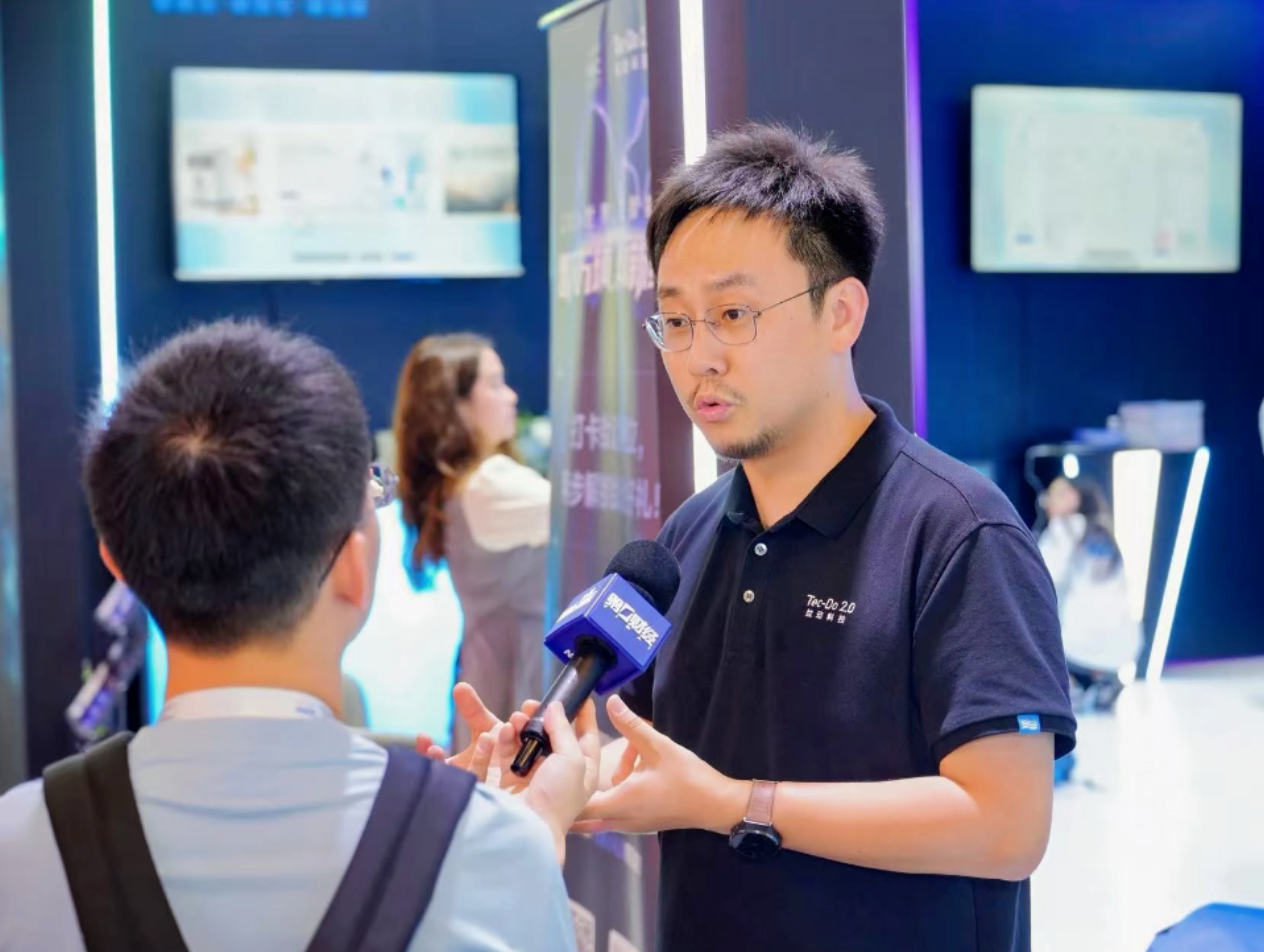
2026-07-23During the 2026 World Artificial Intelligence Conference (WAIC), Tec-Do’s booth at the Shanghai World Expo Exhibition and Convention Center attracted sustained attention from visitors and the media. Following the official debut of Navos 2.0, Tec-Do’s AI marketing agent platform, dozens of media outlets visited the booth to interview Li Shuhao, Founder and CEO of Tec-Do, on topics including product innovation, industry development, and real-world commercial applications.
During the group interview, Li shared his latest perspectives on the industrialization of AI, agentic workflows, and global business growth.
The following has been edited from the on-site Q&A for clarity and length.
Q: How does Tec-Do help companies expand globally?
Li Shuhao: Tec-Do is an AI-powered marketing technology company. For us, marketing is only the starting point. What we ultimately want to build is “Tec-Do Business”—using technology to enable companies to do business globally.
Advertising is the most visible commercial component of marketing and an important way to generate revenue, but our technology can support a much broader range of global expansion activities. We focus on deeply integrating AI with real-world industries and have developed specialized foundation models and multi-agent systems for global business scenarios.
Companies expanding internationally often face challenges across product selection, promotion, inventory planning, and value proposition development. Instead of relying on traditional consulting-style insights, we use AI agents to address these challenges. Multimodal AI generates marketing content at scale, while real-time campaign data is used to continuously optimize ROI.
This creates a complete agent-driven loop covering insight, generation, media activation, and optimization—with the ultimate goal of helping our clients generate real business results.
Q: Is the advancement of AI a turning point for global marketing?
Li Shuhao: AI is not only a turning point for global marketing. It is a turning point for every knowledge-intensive industry.
In the past, market research and content creation generally had to be carried out by highly educated and experienced professionals. Today, AI is beginning to reshape knowledge work.
Navos 2.0, the AI marketing agent platform we launched this year, is built around the concept of an Agentic Workflow—bringing AI agents into real-world business workflows. The transition from manual production to assembly lines and the transition from conventional software to AI agents represent comparable shifts in productivity.
In the future, virtually every industry will be rebuilt through this transformation.
Q: How is Tec-Do using AI to transform traditional global expansion models?
Li Shuhao: The globalization journey of Chinese companies can broadly be divided into three stages: OEM manufacturing, ODM production, and the development of global brands.
Chinese manufacturers have already built strong product capabilities, but brand building remains their biggest weakness. In the past, Chinese companies largely followed Western rules for distribution channels and consumer mindshare. Today, global competition is shifting from a model based on division of labor to one characterized by parallel competition. With additional pressure from the reshoring of manufacturing, establishing a strong position in consumers’ minds has become increasingly urgent.
At the same time, product discovery is moving away from shelf-based search toward social recommendations and AI-powered conversations. This requires brands to build a more systematic and interconnected network of consumer touchpoints.
With agentic workflows at its core, Navos 2.0 helps companies overcome cultural and consumer barriers, address practical challenges in global markets, and move from simply exporting products to building brands internationally.
Q: Many companies are developing AI-powered insight and content-generation solutions. What differentiates Tec-Do?
Li Shuhao: Our core advantage lies in our understanding of specialized, industry-specific data.
Even the most capable person cannot cook without ingredients. Much of the data required in professional business scenarios cannot be found on the public internet, which is why we need to train our own specialized foundation model, Tec-Chi.
General-purpose models have raised the baseline level of intelligence. What Tec-Do provides is the equivalent of a university-level textbook: specialized knowledge derived from years of accumulated business experience.
Subject to proper authorization and compliance requirements, we transform data from content consumption, advertising delivery, and conversion feedback into specialized datasets. We analyze elements such as high-performing video frames, the articulation of product benefits, emotional shifts, and audience feedback. These insights are then used to optimize both our models and business strategies.
Because the data is updated every day, the models and the business form a continuously reinforcing feedback flywheel. As a result, Navos does not simply provide general recommendations. It delivers actionable judgments tailored to specific markets, platforms, product categories, and creator scenarios.
In the SuperCLUE-Mkt benchmark for specialized marketing models, Tec-Chi’s question-answering and reasoning model ranked first globally. This reflects the combined advantage created by specialized data and specialized models.
Q: What are the most important upgrades in Navos 2.0 compared with the previous generation?
Li Shuhao: Navos 2.0 includes two major upgrades: a comprehensive upgrade of the multi-agent system and a fundamental reconstruction of the underlying Navos platform.
At its core, the platform has evolved from answering questions to getting work done.
Architecturally, we have moved away from a set of fixed, preconfigured agents toward a model built around a Workstation and Navos Team. The Workstation supports standardized collaborative workflows, which then enable the Navos Team to execute and deliver real business outcomes.
The training model has also changed. Previously, training was primarily conducted by a dedicated group of experts. Navos 2.0 now combines preconfigured foundational content with a system that allows every user to participate in training.
The platform no longer stops at helping clients clarify their understanding of a problem. It can directly execute tasks and deliver results.
Q: Which capabilities are most in demand among companies at different stages of global expansion?
Li Shuhao: The needs of companies vary significantly depending on their stage of international development.
For companies entering overseas markets for the first time, the greatest need is market insight. They do not yet understand the market or know what local consumers prefer.
In the value-added “smile curve,” research and development and market development sit at the two highest-value ends. Chinese companies are already highly capable in R&D, manufacturing, and supply-chain management. What they often lack is the ability to determine what to produce, where to stock it, and where to sell it. That is why market insight is the most important capability for newcomers.
More experienced companies, by contrast, often lack sufficient content-production capacity. A large number of products are launched in China every day, but each one needs to be presented in a way that resonates with local consumers.
Companies need to determine which creators to work with, including their appearance, age, and audience profile; what those creators should say; how the shots should be structured; and when the product and promotional offer should appear.
In the past, companies had to find local actors, models, and filming locations, and the process could take two or three months. Today, multimodal models can rapidly generate product videos, product messaging, and descriptions without requiring teams to travel overseas.
Q: Navos 2.0 includes an AI comic-drama agent. How did Tec-Do expand from conventional global marketing into this area?
Li Shuhao: In the past, China’s global expansion was primarily driven by the export of physical goods. We are now seeing a new wave of international growth driven by services.
In this context, “services” refers not only to conventional service industries, but more importantly to the global distribution of Chinese culture. The previous wave was represented by Chinese games expanding internationally. The next major wave is likely to include short-form dramas, animated comic series, and other content products.
AI has been a major reason why this market can develop so quickly. Producing a drama and producing an advertisement involve similar underlying logic: both require an understanding of local consumer preferences.
Chinese audiences may favor genres such as xianxia fantasy or time-travel stories, while European and American audiences may be more interested in vampires or werewolves. Every country and culture has its own characteristics.
AI can understand these differences and generate scripts, characters, and content suited to individual markets. The market is still at an early stage, but it has the potential to generate considerable momentum.
Tec-Do does not intend to produce comic dramas itself. Instead, we are extending the capabilities we have developed through e-commerce, advertising, and creator marketing into the global distribution of cultural content. We provide clients with the solutions they need for AI-powered content production and international distribution.
Q: How does Navos 2.0 differ from the mainstream preconfigured, general-purpose toolkits currently available?
Li Shuhao: Navos 2.0 is a scenario-specific product that comes with built-in business skills and a complete working environment.
Many preconfigured tools currently available on the market have a relatively high barrier to entry. Users must configure websites themselves, write search instructions, conduct preliminary training, and define agent personas. The process is complicated and difficult to scale among mainstream business users.
Tec-Do preconfigures all the necessary capabilities and retrieves training content from its proprietary databases, allowing Navos 2.0 to be used out of the box.
Our users are not AI enthusiasts. They are business professionals working in areas such as cross-border e-commerce, creative production, and operations. We therefore need to build a bridge between technology and business. This is also one of the main priorities of our current technology investment.
Q: Will consumers eventually ask AI to select and purchase products on their behalf?
Li Shuhao: It is not a question of whether this will happen. It will inevitably happen.
The future will be an A2A, or Agent-to-Agent, economy, in which every individual will have a group of AI assistants. However, the consumer agent is only the second “A” in A2A. The first “A”—the enterprise agent—is actually more difficult to build.
Suppose a consumer says, “I want to buy a gimbal suitable for travel photography.” The consumer-facing agent needs to understand that person’s budget, use cases, and preferences. On the enterprise side, however, the company must clearly communicate the product’s functions, core selling points, target users, content assets, inventory cycle, and marketing strategy before supply and demand can be accurately matched.
Tec-Do primarily serves the first “A”: the enterprise agent.
Our goal is to turn the products, content, and operating expertise of Chinese companies into agent-readable intelligence. Information that was previously scattered across product-detail pages, short-form videos, advertising platforms, and internal company systems must be transformed into data that agents can understand, verify, and use. It can then be connected with consumer-facing agents through technical protocols.
The form of marketing will therefore change. In the past, brands primarily considered how to be seen by people and how to persuade them. In the future, they must also consider how to be understood, verified, and selected by AI agents.
As enterprise agents and consumer agents begin to work together, product discovery, demand matching, and transaction services will all be reorganized. This is what we mean by Agentic Commerce.